
BendingActive.
Metal Panel Deformation
A research story about geometry, openings and the behaviour of a metal sheet.
Individual thesisNational Cheng Kung University
The shape beginswith an opening.
A desired surface is only the beginning. This thesis asks how the geometry of a cut pattern can help a metal sheet take that form.
Miura folding represents the surface’s local angles. Those angles link the overall shape to a repeatable operation at the scale of one opening.
A relationship between design intent and material behaviour.
Explore the surfaceScroll to explore. Click or tap the model to compare sources.From a flat grid to a folded surface
Read the net, folds and form.

From angleto pattern.
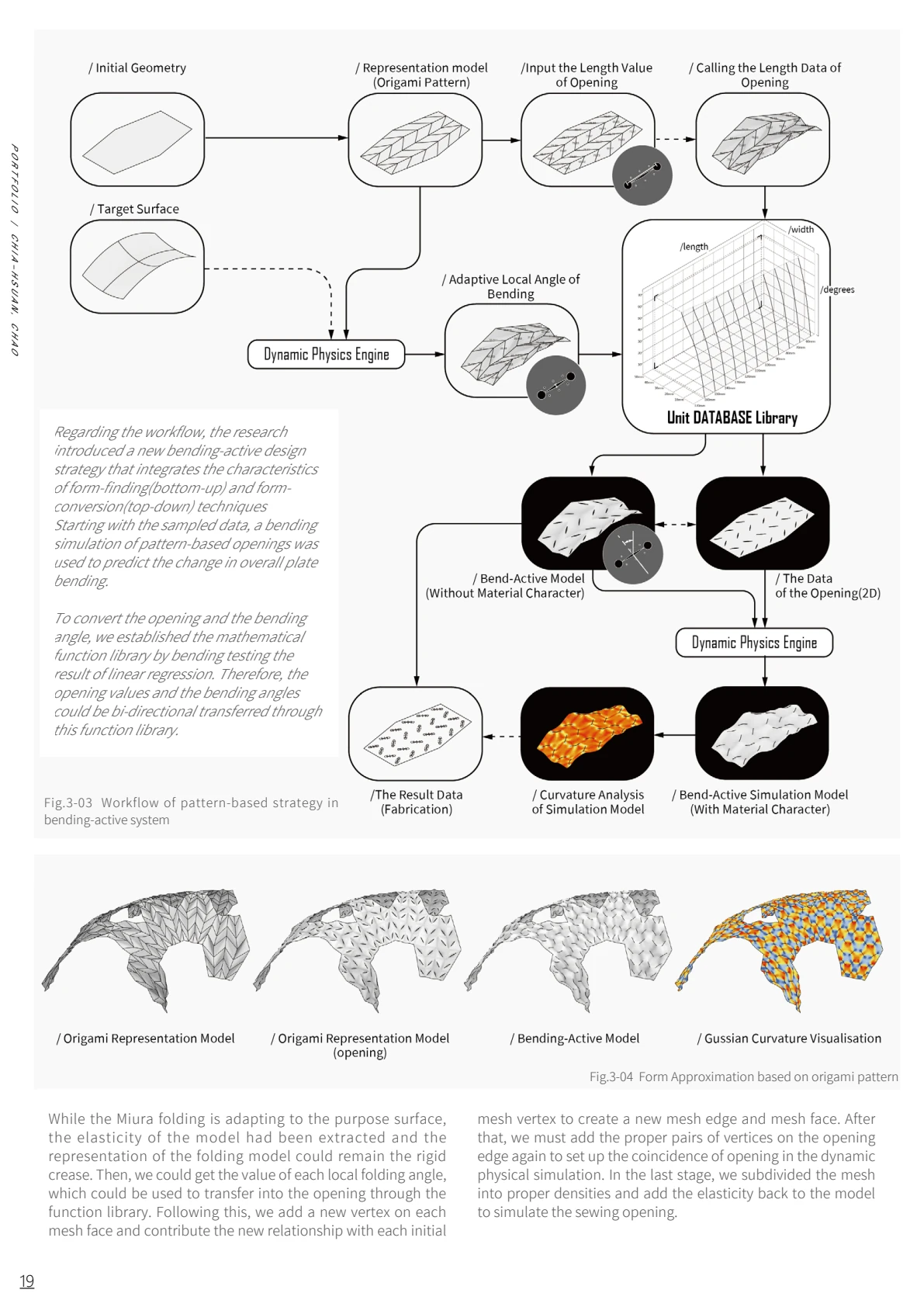
I developed an individual thesis workflow connecting Miura representation, a regression-based opening library and dynamic physical simulation.
The opening values inform a reconstructed mesh. Paired edges then describe how the openings close and the panel bends.
01Target surface
Start with the desired surface geometry.
02Local angle
Miura representation describes the surface’s local angles.
03Opening pattern
A sampled function library relates opening dimensions and angle.
04Bending model
Paired edges describe how openings close and the panel bends.
Read the design-to-fabrication sequence
Follow the workflow. Select a stage to compare its model.

Compare with the original thesis figure
 Inspect evidence
Miura representation connects opening patterns with a bending-active surface.
A local rule.A different surface.
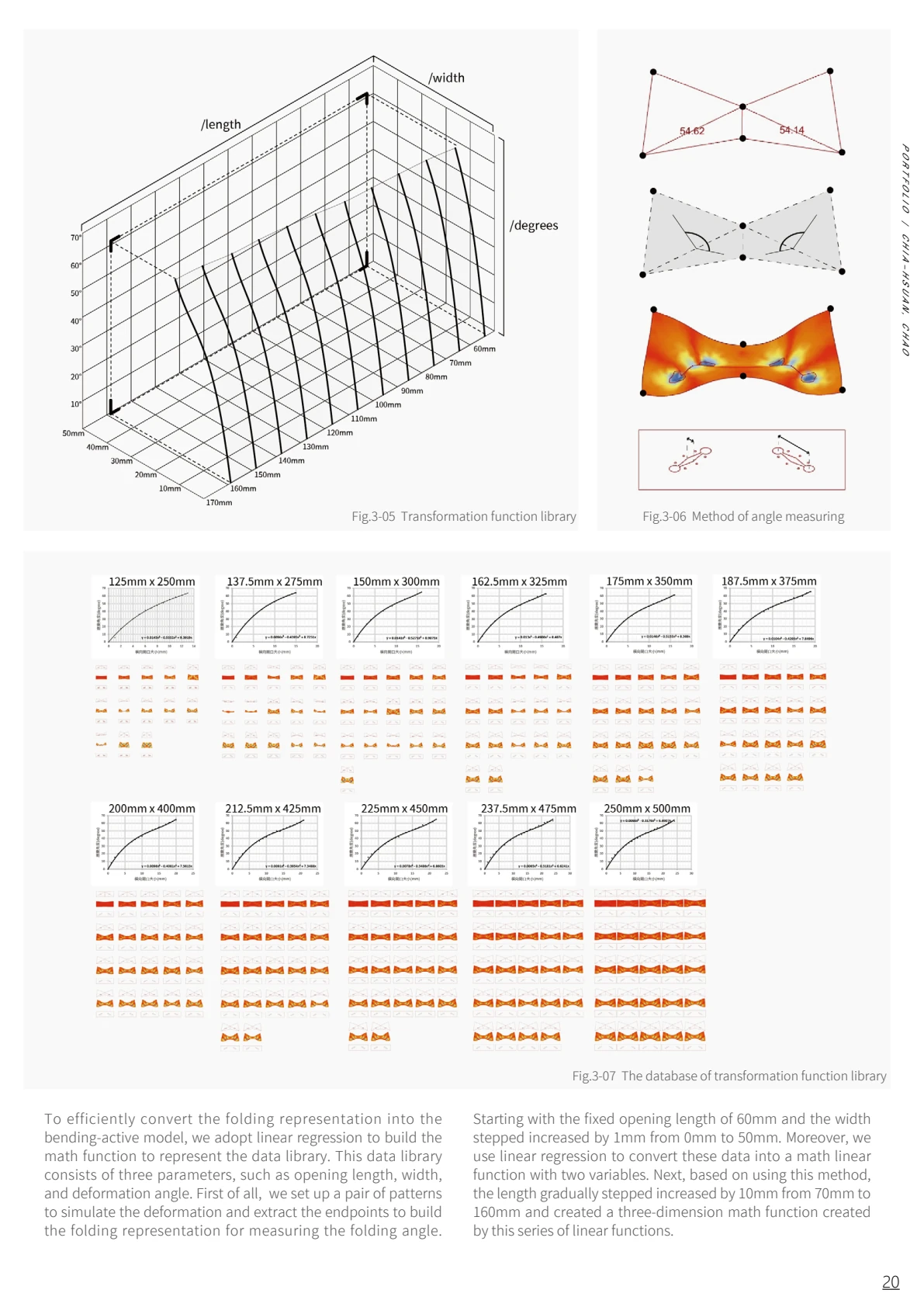
The research relates opening length and width to bending angle through a sampled function library.
Arc, twist and saddle mock-ups explore how those local relationships accumulate into different surfaces.
The opening-pattern library links sampled dimensions with bending angle; the physical studies explore that relationship across several surface types.
Follow the sampled function library
Length traces unfold from 60 mm to 160 mm.

Eleven original length traces. The sequence reveals the authored drawing; it does not calculate a new structural prediction.
Read the original library figure
 Inspect evidence
Opening length, width and bending angle in the sampled function library.
 Inspect evidence
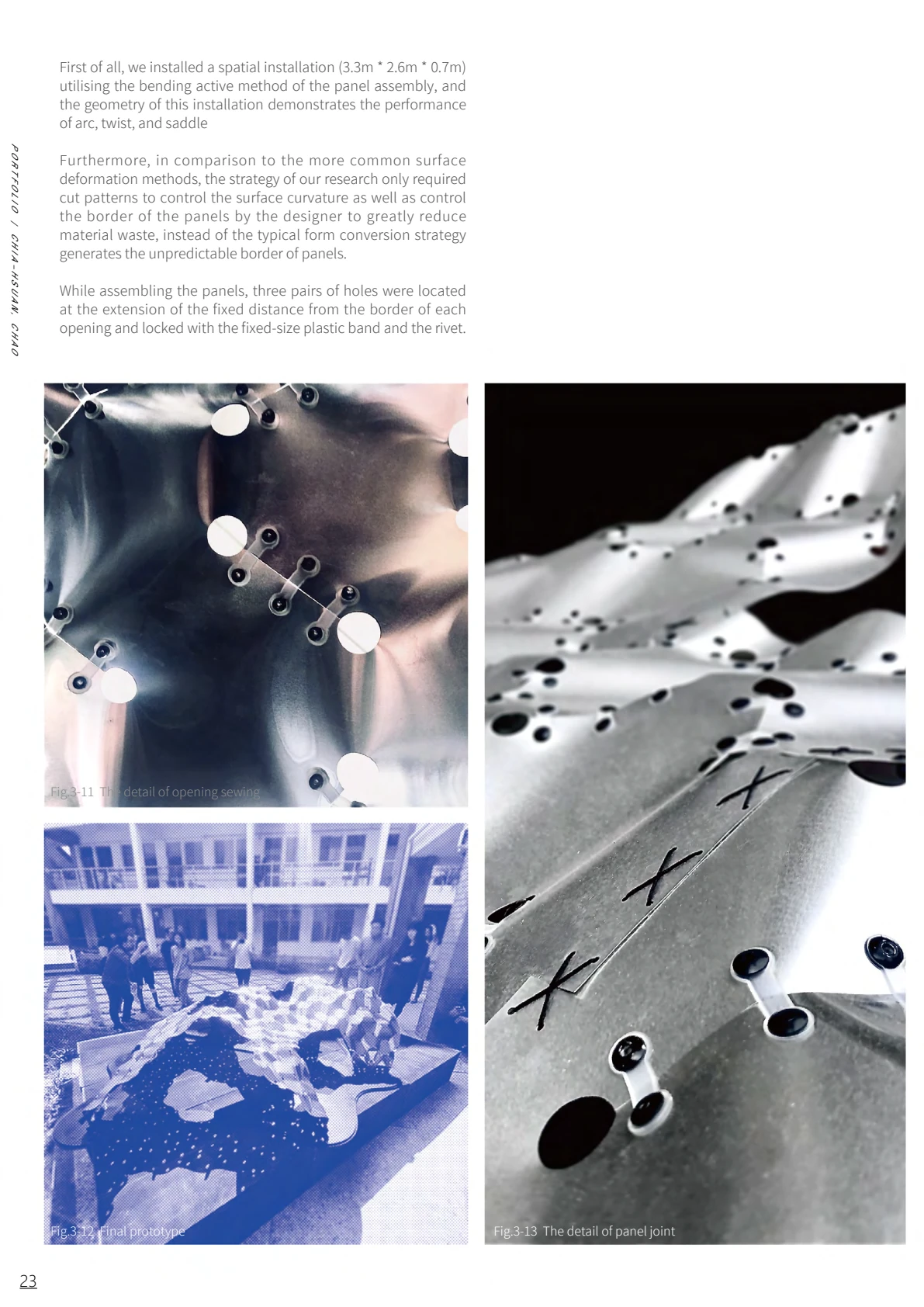
A physical panel joint, with stitching and fasteners visible.
Sewn intospace.
Pairs of holes and plastic ties close the patterned openings. Panel connections, including rivets, bring the separate sheets into a spatial prototype.
The joints remain visible: the method becomes part of the object’s expression.
- panels, reported
- 16
- prototype, reported
- 3.3 × 2.6 × 0.7 m
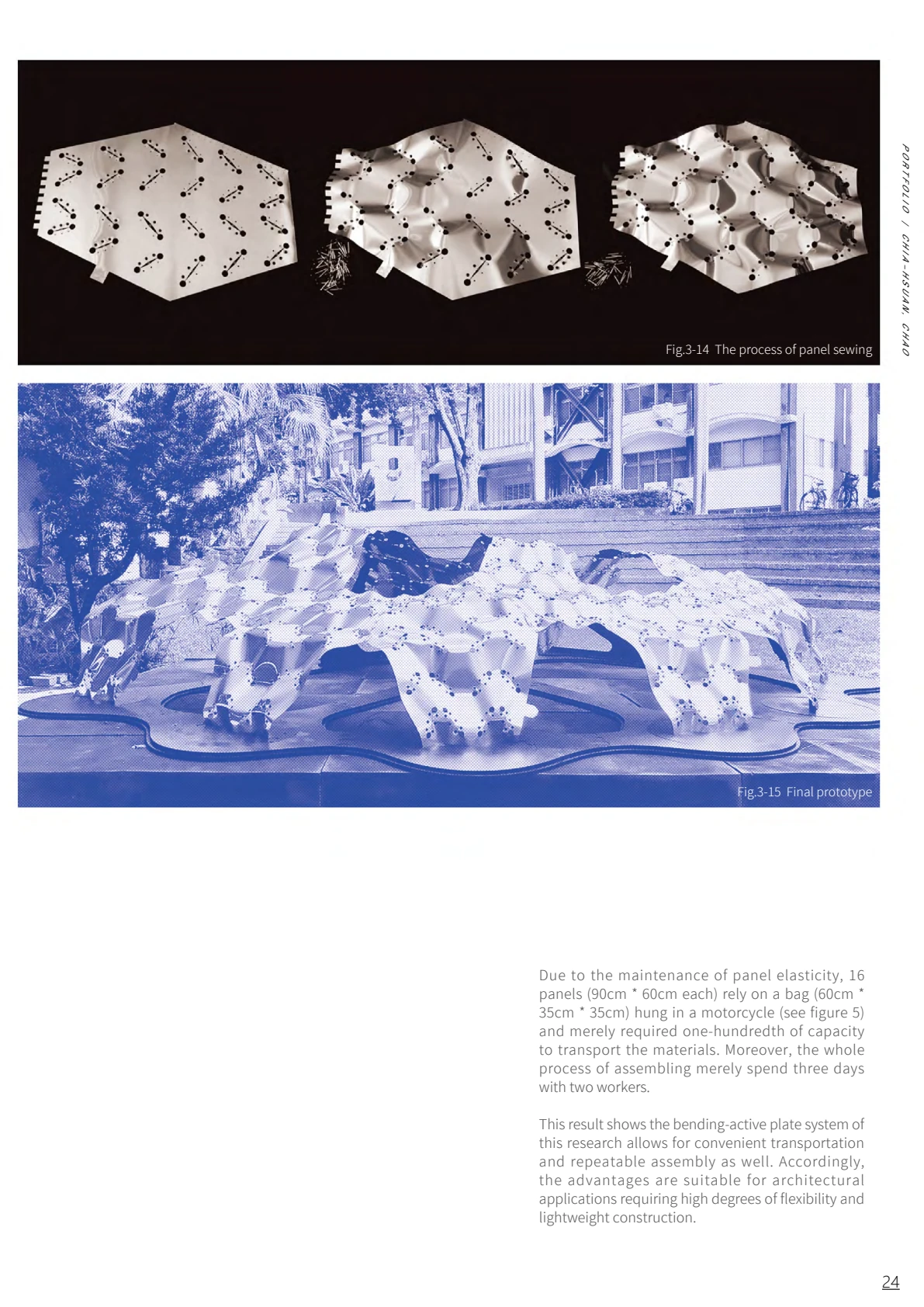
Two people assembled the spatial prototype over three days.
From simulationto the made object.
I compared simulated forms with physical mock-ups and brought the patterned panels together in a spatial installation. The assembled prototype made the relationship between openings, seams and curvature tangible.
The digital model lets the surface, connections and assembled form be examined together.
The available evidence does not establish structural certification or universal prediction accuracy.
 Inspect evidence
The assembled installation, photographed on site.
Intent,translated.
Target geometry, local opening rules and physical prototyping become one connected design workflow.
I developed this individual thesis at National Cheng Kung University under the supervision of Prof. Kane Yanagawa. I combined Miura-inspired surface representation, an opening-pattern library, linear regression and dynamic physical simulation to connect target geometry with the deformation of metal panels.
Arc, twist and saddle studies led to a spatial prototype assembled collaboratively from patterned panels.
Geometry inspection only. No structural analysis or fabrication validation runs in the browser.